Columns in reports: how to display information the way you need
Customizing columns in Everhour reports allows you to tailor your data views to display exactly the information your team needs. You can choose which columns to display, adjust their width, reorder them, include project and member custom fields, and build custom mathematical formulas using Calculated Columns.
Adding, Reordering, Resizing, and Removing Columns
You can configure the column layout of any custom report during creation or while editing an existing report:
- Go to the Reports page and open or create a custom report.
- Switch to the Layout tab in the report sidebar.
- Add Columns: Browse or search through the list of available metrics and dimensions on the right side, then drag them into the active columns list on the left (or click the + icon next to the column name).
- Quick Add: Click the Quick Add Field menu directly in the report header to search for and insert specific fields on the fly.
- Reorder Columns: Drag columns up or down in the active list on the Layout tab to change their left-to-right order in the report table.
- Resize Columns: In the report table header, hover over the border between two column headers until the resize cursor appears, then click and drag the divider left or right to adjust column width.
- Remove Columns: Click the x icon next to any active column in the sidebar to hide it from your report.


Available Column Types & Custom Fields
Everhour reports support a wide range of standard dimensions, financial metrics, and custom fields across projects and team members:
- Time & Progress Metrics: Logged time, billable time, estimates, overtime estimates, time remaining, and total time.
- Financial & Billing Metrics: Billable amount, cost rate, billing rate, project budgets, and expense amounts.
- Project & Task Dimensions: Client name, project name, task title, task status, tags/labels, and task URLs.
- Team Dimensions: Member name, user role, and timecard data (clock-in, clock-out, break duration).
- Project Custom Fields: Custom fields (numeric, text, dropdown, or date) created inside Everhour or synced from integrated tools like Asana, Trello, ClickUp, or Monday.com.
- Member Custom Fields: Custom attributes configured for team members on the Employee Data page.
- Supported Field Types:
Text,Number,Date, andSingle Select. - Report Layout Group: Found under the dedicated Member Custom Fields group on the Layout tab. (Note: Number-type fields are listed in this group but are automatically aggregated as numeric metrics in report tables).
- Quick Add & Search: Accessible via the Quick Add menu under the Members section, complete with real-time keyword search.
- Supported Field Types:
Calculated Columns (Formula Columns)
While standard columns show raw metrics like tracked time or costs, Calculated Columns allow you to perform real-time math operations directly inside Everhour—eliminating the need to export reports to spreadsheets to calculate margins, markups, or realization rates.

How to Create a Calculated Column
You can create a new calculated column using two convenient entry points:
- From the Layout Tab: In the report editor sidebar, go to the Layout tab and click the New formula link.
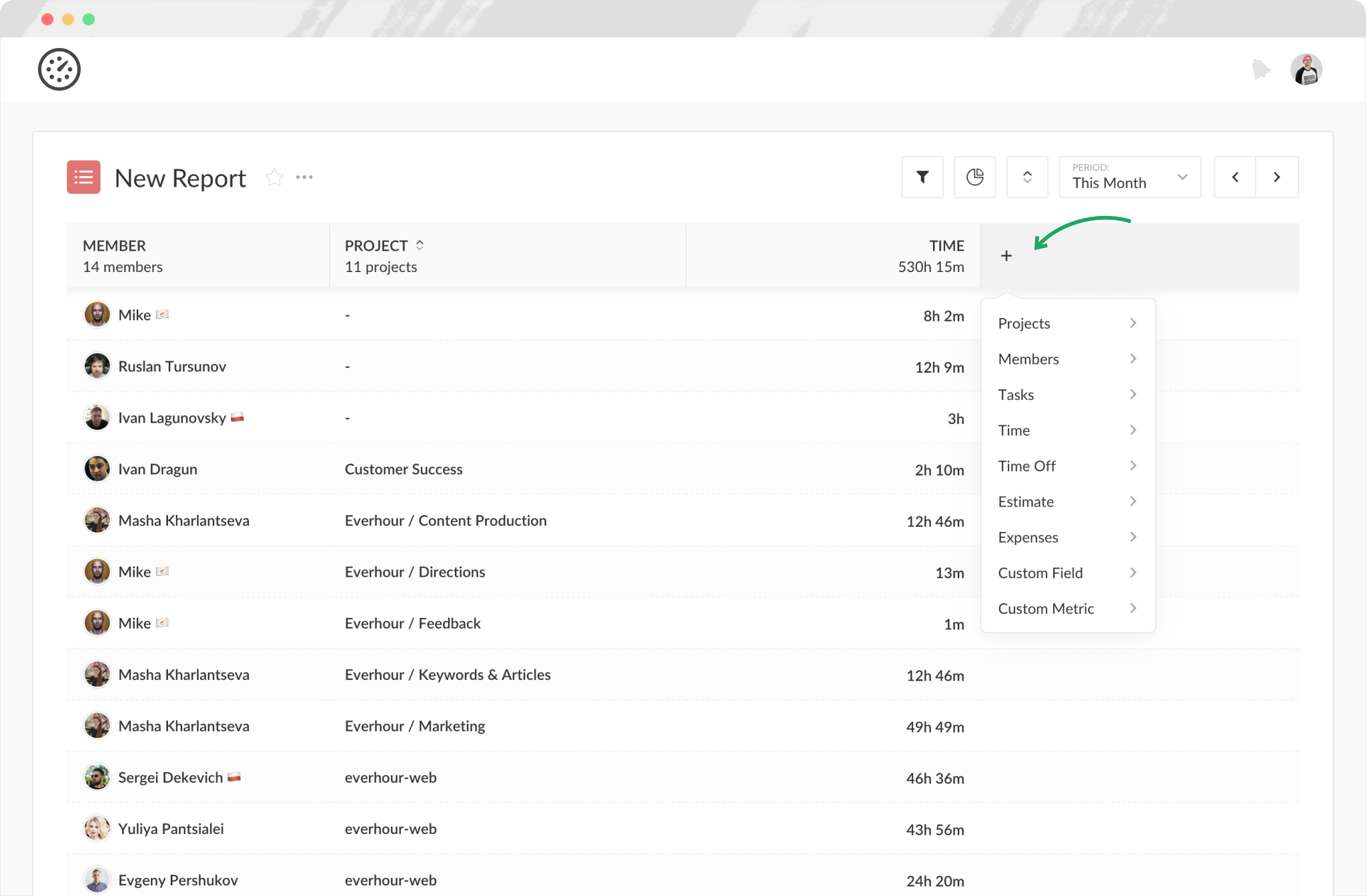
- From the Report Table: Click the + (plus) icon in the table header row and select Formula.
This opens the New Calculated Column modal:
- Column Name: Set a name for your custom column (up to 50 characters).
- Formula Expression: Write your equation using basic math operators (
+,-,*,/). You can click on available fields in the metrics list or manually enter column names enclosed in curly brackets (e.g.,{Total Time} * 1.5). - Format & Precision: Choose the display format (Number, Time, Currency, Percent, Label, or Unformatted) and set decimal precision (from
0to5places). - Save: Click save to compute and display your calculated values across all report rows.
Capabilities & Scope
- Allowed Parameters: Numeric constants and Number-type metrics (standard Everhour time/cost metrics or custom numeric project/member fields).
- Report Scope: A calculated column exists only within the report in which it was created. If you unselect a formula column while the layout settings remain open, you can re-select it; once the editor is closed, unselected formula columns must be recreated.
- Tooltips & Charts: Hovering over a calculated column header displays a tooltip reading: "A column calculated from other columns using a formula." In report charts, calculated columns display as metrics.
- Sorting & Editing: You can sort report data directly by a calculated column, edit its formula via the column popover, or permanently remove it using the Delete Column button (with a confirmation prompt).
Validation & Column Dependencies
The formula editor validates expressions in real time, displaying "Formula is valid." when syntax is correct. Common validation warnings include:
Empty column referenceUnknown column {name}Formula is incompleteUnexpected "/"
Required Metric Dependencies
Certain metrics change how Everhour aggregates report rows. If your formula uses one of these metrics but the metric itself isn't present in your active layout, a warning banner will request that you add the required column:
- Budget: "Budget can only be used when the report also shows the Budget column, because that column changes which rows the report produces."
- Time Off: "Time Off can only be used when the report also shows the Time Off column, because that column changes which rows the report produces."
- Expense Amount: "Expense Amount can only be used when the report also shows the Expense Amount column, because that column changes which rows the report produces."
Permissions & Visibility Rules
Column visibility in reports adapts based on user permissions, project access, and feature settings:
Role-Based Access
- Admins: Can select and view all standard metrics, financial columns, project/member custom fields, and formula parameters across the workspace.
- Members, Limited Members, & Supervisors: Can access standard time metrics (Estimate, Estimate Overtime Only, Estimate Remains, Expense Amount, Time, Time Off, Total Time). Expense and Time Off columns hide automatically if their modules are disabled.
- Restricted Fields: Non-admin users cannot view or create calculated columns that reference member custom fields, financial metrics (cost/billing/budget), or custom fields for projects they do not belong to.
External Changes & Deletions
- Revoked Project Access: If a user loses access to a project whose custom field is used in a calculated column, that column is hidden from their view without showing error icons.
- Deleted Custom Fields: If a custom field used in a formula is deleted from the account, the calculated column is hidden for all users.
- Renamed Integration Fields: If a custom field name is changed inside an integrated tool (e.g., Asana), the formula editor will highlight the former field name as invalid, requiring manual updates.